Monday, 12 October 2009

Freaky Season

Gooder's dissection of various examples of the horror genre over at My Front Room has been chugging away for a little while now, my erstwhile flatmate has finally strayed into sacred ground: Romero's Dead series.

A couple of caveats. First, there is no doubt that Gooder is right that neither Land of the Dead nor Diary of the Dead can be particularly considered worth anyone's time. I'd consider the former entirely inessential rather than terrible, and even the latter has its moments (I also don't think it's fair to suggest that showing both sides of an argument is the same as not being sure of what one wants to say), but I'm not particularly inclined to defend them too vociferously, not when the difference of quality between those films and the ones that preceded them is so undeniable.

No, Gooder's true heresy lies in his entirely unforgivable suggestion that Day of the Dead is less impressive than it's predecessor, Dawn of the Dead.

The argument that the two films tread the same ground is superficially compelling; both involve a small group of survivors attempting to not get bitten by the hordes of zombies outside the complex they have locked themselves inside. Both contain the message that ultimately it's not the zombies we need to be worried about, but our fellow humans (though they do this in very different ways, and that particular theme is a long-established staple in disaster movies, which the ...Dead series can just about be considered to be, if one squints hard enough).

Beyond that, though, the two films are surprisingly different. If anything, Day... is the entirely logical progression of Dawn..., and for more reasons than simply being set after it (the only way in which the film can be considered a sequel beyond the zombies themselves). The former film asks how one would respond to society crumbling. The latter considers what happens once society has crumbled, past tense, and ain't never coming back. To take one example, Dawn... concludes with an attack on the protagonists' mall by a gang of anarchic bikers. By this point of the dead's inexorable replacement of the living, one still needs to be concerned about looters.

It would never occur to the survivors trapped inside the bunkers of Day... that they might need to guard against looters. The hordes of zombies have become an impenetrable ocean, all that the exhausted humans can see in any direction. Whilst Dawn... chronicles our fall, Day... kicks off by asking... what now? The stress of surviving Dawn... drives Peter to within inches of committing suicide out of sheer despair. Almost every character in Day... starts out that horribly damaged.

Much has been made, and I think fairly, of Dawn...'s indictment of consumer culture. Bored? Go shopping. World ending? Go shopping. Not sure where to find delicious brains? Go shopping, and eat the shoppers. The corollary to this, though, is that the survivors use the mall as a way to block out the truth regarding their situation, in the same way anyone might use retail therapy to distract themselves from the problems in their life. Dawn..., at its core, is about fiddling whilst Rome burns.

The only fiddling the characters in Day... are doing is with zombie brains and power drills (and their own sexual organs, apparently, though the less said about that the better). Not for them the questionable delights of mannequin target practice; they have a job to do. They have to turn back the zombie invasion. What makes Day... so much bleaker and harrowing is that whilst the characters in Dawn... needed only to survive, those in Day... have been given a mission. It's a mission that is obviously, unquestionably impossible, and moreover had a strict time-limit long since expired, but they keep doing it because there is no other choice, and because if they do give up, it means genuinely accepting that the end has come and gone.

Or is there? I wrote something about Day of the Dead in the run up to Halloween last year, as part of a larger article on horror films dealing with the apocalypse, and now seems a good time to dig it out:

The film concentrates on the various ways the characters (soldiers and scientists, drunks and evangelicals) process the fact that humanity's time is passed. If anything, the film is the Kubler-Ross model (denial, anger, bargaining, depression, acceptance) applied to celluloid, only the one dying isn't a person, it's a civilisation at best and a species at worst. Logan is denial, convinced that he has a way to keep humanity alive, even though it's obvious to everyone else that it cannot possibly work (how exactly he expects to millions of zombies tamed by constantly feeding them human flesh is a question best left answered, although it does feed my pet theory by being the bargaining part of the equation, "Have this food and don't eat me, please!"). Rhodes and most of his men are anger, blaming the scientists for their predicament and their losses, determined to "blow the piss" out of the enemy even though they know they don't have enough bullets, let alone men, to do the job. Salazar, fairly obviously, is depression, and for much of the film, so is Sarah. She might be more level-headed than anyone else (with the possible exception of Fisher), but she's still massively strung-out, still lamenting the loss of what she personally and humanity in general had, and terrified that what little she has left (including her lover) is about to be lost too. As the film continues though, she begins to reach acceptance, helped out by William and John, who are already there, and are determined to simply live out their lives finding what comfort they can.

In fact, Day... is an even more poignant example of the accompanying sadness I mentioned before, because it focuses on the exact moment the first type of apocalypse film (the sky is falling!) turns into the second (the sky has fallen, and we ain't getting it back up again). The characters have to make a conscious choice to let go of the hope they've held since the crisis began, and find something else to cling to instead. These films are generally about acceptance to some extent, but what makes Day... unique is that it focuses on acceptance by those who were tasked with affecting change. Viewed from this angle, the fear of losing the support of society becomes instead the fear of being forced to change, to re-write one's internal assumptions and certainties.

Strangely, then, whilst Day... is on almost every level a bleaker film than Dawn..., the central message of processing the past and letting it go is actually more optimistic than observing the gradual numbing of the characters in Dawn... (Peter's last minute change of heart notwithstanding), which manages to end the trilogy on the highest possible note one could expect without cheating the audience (well, the final helicopter nightmare is a cheat, but still).

All of this is without mentioning the film's ace in the hole, Bub (who, to be fair, Gooder holds up as the best part). Bub exists as a sort of twisted reminder that every ending is a beginning (which Romero expands upon in Land..., with admittedly distinctly mixed results), and as the most direct demonstration yet that there are worse things in Florida than the stenches. He is also proof made (rotting) flesh that hoping the clocks will turn back is simple insanity, which of course pushes Sarah closer towards acceptance (and Rhodes closer towards a psychotic break).

There are other reasons to hold Day... up as superior to Dawn..., the acting and characterisation are better, and the zombie make-up is more disturbing (the first shambling horror we see roaming the streets of an abandoned city is possibly the best zombie yet committed to celluloid, though unsurprisingly this isn't a uniform standard throughout the film). Mainly, though, it simply feels like a more human film, even if most of the actual humans invariably behave like jerks, and/or get horribly killed, and one that has a message that feels important, rather than just snarky.

Sunday, 11 October 2009

Increasing Competition

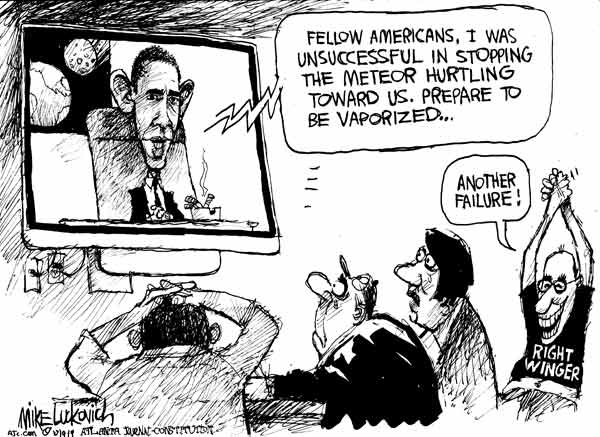
Have decided to add Balloon Juice to the blog-roll, despite it being yet another site dedicated to covering American politics. I make no apologies for the apparent repetition; not only did the site put me on to the whole "Let's re-write the Bible to stop people knowing what they're doing making it more accurate" thing, but it also gave me this cartoon, which amused me greatly.

Dear Marvel: Either They Mutate, Or You Do


Right. This has gotten silly, and it has to stop.

I am on record as something of an M-Day apologist. For the uninitiated, and in as few words as possible, four years ago (in real time, which would theoretically make it around eight months ago comics time, but several sources, mainly Messiah War, contradict this) an insane Scarlet Witch used her reality-warping powers to attempt to remove all mutants from the world (and, as it later transpired, across multiple alternate dimensions). She was not entirely successful, but the mutant race dwindled almost immediately from the hundreds of thousands to just hundreds full stop.

When I say I am a quasi-apologist for this set-up, I mean only that conventional wisdom has it that this was a very bad idea in concept. I disagree. I think it's actually a very good concept, it's just been totally bungled in practice.

There are three incredibly obvious advantages to the idea. Firstly, it changes the metaphor. Ever since Claremont the X-Men have, at least nominally, been a metaphor for the Civil Rights movement. Sure, it's often been stretched to breaking point, but it's still always there in the background.

Reducing the mutant population to a comparative handful allows the metaphor to be recast, without it being entirely altered. Mutants are no longer analogous to black people or homosexuals, but to Native Americans. A previously formidable force now in its last days. No longer are mutant rights (and the accompanying terrorist attacks, lynchings, riots and so on) an urgent problem that the government must face, they're now something that can simply be swept under the carpet until the mutant population dwindles into non-existence. The decision to house the 198 (the number of mutants listed by the US government that retained their powers) at the Xavier Institute reinforces the parallel; at this point the school essentially becomes a reservation.

Of course, while there are many fascinating and melancholy stories one could tell about the slow fade of the Native American tribes from the pages of history, I grant that such tales are unlikely to sit well within a monthly comic book. The key difference though lies in the sheer number of organisations created exclusively to combat the mutant "threat" that suddenly find themselves a) on the verge of victory, and b) with only one remaining target to deal with [1]. So it's not as though there's a lack of potential for action (as made clear by the Purifiers strike against the Institute that left no fewer than 45 former mutant children dead). Just off the top of my head, you could utilise the Purifiers, the Sapien League, the U-Men, even remnants from the Friends Of Humanity, all without even having to reach for an evil mutant at all.

True, there would only be so many times that you could pit ordinary humans (however bat-shit insane) against the X-Men in a straight-out fight, but that feeds into my second point. A definite potential advantage of the M-Day board-sweep is that it could have forced writers to tell their stories with a smaller cast of characters to rely on. This could well be difficult for scribes used to being able to throw new super-powered characters into the mix whenever they want, but the necessity of relying on a much smaller group of heroes and villains would force greater character development and interaction. One of the most common (and accurate) criticisms of the '90s X-Books was that important/beloved characters would fall through the cracks, sometimes for years, without explanation, because too much emphasis was always being placed on the latest new threat or taciturn loner hero. Consider Battlestar Galactica, which managed perfectly well for at least for two and a half seasons with what it started off with, adding new characters only sparingly (to the point where episodes in which new characters suddenly appeared were roundly criticised for being lazy). Again, I recognise what works for dour space-opera television won't necessarily wash for superhero comic books, but the opportunity to weave the surviving mutants into a coherent narrative should not be quickly dismissed.

Speaking of characters, the third benefit of M-Day is the possibility to generate very strong drama amongst the mutant population, both for those still powered (survivor's guilt, suddenly feeling alone and without back-up) and, most especially, for those which are not. This is the other side of the coin from the repeated "secondary mutation" storylines, or the more general messing around of characters like Psylocke. What happens when lifetime of extreme change (or at least potential extreme change) suddenly becomes the same forever, and when what made you special is arbitrarily removed?

That's how I would have tackled the X-Men after M-Day, anyway. A combination of siege mentality and political maneuvering by what remains of the mutant population (divided into clear factions with a purpose for being, rather than just the Acolytes and the Hellfire Club sulking about their loss of status) in the face of a world that either wants them to die out or to be killed as quickly as possible, with the focus on the preciousness of each mutant life remaining, the trials of those left powerless, and the reveal of each still-powered mutant a rare and important event.

It might not have worked, naturally, but I think it would have had a better shot at working than what we ultimately received. What actually happened was that the writers tried to have their cake and eat it. M-Day led to an awful lot of moping around; mainly from Beast (which was at least interesting and led to Endangered Species, which is horribly underrated) and from Cyclops, (which wasn't interesting in any way at all) along with endless references to M-Day, but nothing really changed. Of all the X-Men, only Polaris lost her powers and dealt with it "on-screen" [2], and since at that point she was just a hideous, lunatic mess of a character, her crisis never came close to offering any dramatic power. New mutant characters continue to be introduced, with almost no appreciable slackening of speed, which both undermines the alleged dire straits of the mutant population and irritates long-time fans through the implication that while well-loved and well-established characters have been neutered, [3] brand new faceless mooks can still show up at any time (UXM #515 brought this home with the arrival of five brand new mutants, not one of which I have any reason to give a crap about). This also meant that the golden opportunity to attempt to allow a smaller group of characters to interact more regularly was lost, in favour of the typical mutant-of-the-week approach to X-Men stories that were precisely what M-Day was designed to prevent.

So, yeah, a great opportunity almost entirely wasted in practice. I say almost entirely because there have been a few good uses of the concept. Having the O*N*E Sentinels become the defenders of mutant-kind was a lovely touch (though again almost nothing interesting was done with them). Beast (one of my favourite X-Men) has gotten plenty of mileage out of the crisis, first with Endangered Species, and now with his Super Secret Science Genius Club, which alternates between time-travelling fact-finding missions and duels in barbed, erudite sarcasm. Messiah Complex and its sequel Messiah War could both have been done without M-Day, Hope's rarity could quite easily be replaced with just making her much, much more powerful, but it genuinely adds an extra layer for the story to be about "the first new mutant birth", rather than just the latest in an endless line of "most powerfullest mutant ever ever" tales.

So it hasn't been a total failure. At this point, though, I don't see what more can come from it. It was only in UXM #500 that the X-Men set up camp in San Francisco, hoping for a new beginning for what remains of the mutant race by setting up its own self-sufficient community, only for their new peace to be shattered by an attack by Magneto. Fifteen issues later, and the X-Men have set up camp on Utopia, an artificial island a few miles from San Francisco, hoping for a new beginning for what remains of the mutant race by setting up its own self-sufficient community, only for their new peace to be shattered by an attack by Magneto. If that isn't proof that the franchise is in trouble, I'm not sure what is. Xavier's mansion was always blown up every few years or so, so in once sense this is nothing new, but ever since M-Day it appears that nothing more is happening than regular "new beginnings" that go wrong, and have to be tried again somewhere else. There is some suggestion that the time the X-Men spend on Utopia might focus on the perils and necessities of nation building, but so far all I've seen is an attack by Magneto, again, [4] and an attack by Emplate, another mutant suddenly revealed to have retained his powers for the sake of a new crisis to throw at the X-Men. Nothing that couldn't have been done before M-Day with a great deal less angst (and I say that as a big fan of angst).

So I'm calling it. M-Day could have worked, but didn't, and at this point clearly didn't to the point where the writers are rehashing the same storylines and fucking them up in the exact same ways as before. We need something new, House of Ideas. Get to it.

[1] I don't really know enough about the time period in question, but I wonder if in the immediate aftermath of the creation of the Native American reservations their inhabitants suffered revenge attacks from US citizens?

[2] Ice Man was supposed to lose his powers too, but Marvel chickened out, which kind of underlines my point about the problems being in execution. If you decide you want to completely change the world in which your stories are being set, then doing it half-heartedly is almost certainly the worst possible approach to take. If you can't commit to the new status quo, why will anyone else?

[3] Of course, looking through the list of de-powered mutants makes it clear that very few major or even former major characters have lost their powers, and that most of those that did have had them reinstated through other means, which just makes Marvel's lack of interest in following through with the idea all the more obvious.

[4] OK, in fairness he simply arrived as the cliff-hanger to issue #515, so it's possible an attack is not forthcoming. The parallels between this issue and #500 are still disappointing, though. Whilst we're on the subject, it's worth mentioning that Magneto was another major player who lost his powers after M-Day and who has now had them returned by technological means. The post M-Day status quo might have been flawed from almost the very beginning, but at this point it's almost a parody of itself, and something needs to be done. Perhaps the mooted third part of the Messiah trilogy may address the problem.

Saturday, 10 October 2009

Zeniths and Brain-Eaters

A chance conversation with a fellow mathematician last night got me thinking about albums. My companion mentioned that as a general rule, he found most artists' first album to be their best. This made me wonder whether there is a stage of musical development that I tend to gravitate towards as well. To explore this I wrote down a list of every band or solo artist for which I owned three or more examples of their work, to see whether a pattern emerged.

Turns out there are 18 artists for whom I own three or four examples of their work, 8 for whom I have between five and nine, and 2 for which I achieve double figures. From this sample, fully 44.4% of the artists peaked at their second album, and 33.3% at their third. Less than a quarter of artists manage anything else. Only 16.7% concur with my friends "First is best" policy.

I actually guessed last night that I would come down in favour of sophomore efforts, and so it appears, at least on first reading. There's more to it than that, however. First of all, it's worth noting that there is a correlation between the number of albums I own by a given band, and the point at which I consider them to have peaked. For 3 or 4 albums, the mean value is almost exactly between the second and third. For 5 to 9 albums, it's exactly between the third and fourth, and for 10 + it's eight and a half, though since there are only two data points in that category (R.E.M. and Ryan Adams, if you care), I'm not sure how much faith to put in that number (especially considering how hard it is to choose a "best" album for artists as changeable as as those two).

One immediate thought is whether or not discovering a band that flowers slightly later encourages me to make greater investment in their records. If a band are still bringing it by album four, it's less likely that they're going to quickly burn out. There's also the law of the brain-eater which makes it clear that if album X is awesome, the chances of album X-1 being terrible is far, far smaller than the chance album X+1 is. Certainly, my first acquisition of Ryan Adams music were his fourth and fifth albums (well, the two two-thirds of albums that eventually got trimmed into Love Is Hell), and in R.E.M.'s case it was album number 8 (the admittedly strong but still massively overrated Automatic For The People). It's also interesting that it's so hard to pick a favourite from those two artists. Partially it's probably because I have more options, but I wonder if also the degree of variation in their work feeds into their longevity, allowing more albums to be recorded, which I then have to pore over attempting to pick favourites.

Perhaps, if I were to be fair, I should look at all the individual albums I own, to see if they tend to be from very early in bands careers. I actually think that that would prove true, but with a collection including well over 250 different artists, I'm hesitant to try.

Nothing's stopping you people, though. Anyone discerned a trend in their own taste? First albums? Sophomore efforts? "Late period" discs?

As a bonus question: can one pinpoint the median value at which the brain-eater appears, and a band suddenly become shadows of their former selves, with almost no hope of recovery. The same gut instinct that tells me I probably have a significant number of debut albums by artists that I never felt compelled to follow up on also suggests the value will be between two and three. Even for the twenty-eight artists for which I have enough material to make a judgement on the brain-eater issue, though, it's hard to decide exactly what qualifies. The point at which a downward spiral begins is usually pretty easy to pick out, but is that exactly the same thing? The second Kings of Leon album is significantly poorer than the first (despite what popular opinion would tell you), but their third and (especially) fourth albums are spectacular, so A-Ha Shake Heartbreak feels much more like a blip than the first signs of grey-matter consumption. You also have to consider competent bands who occasionally rise to the level of excellence, seemingly at random, before returning to their previous level of comparative mediocrity (take James, whose 5th album Laid is way, way better than those on either side, though neither one of them could be considered bad either).

I shall have to ruminate more on this issue; but comments are very welcome. Perhaps we can slap together a statistical model for the journey of the musician. What better way could there be to spend one's time?

Friday, 9 October 2009

Say What Now?

Couldn't let today go by without mentioning how ludicrous it seems to me that Obama won the Peace Prize. Glenn Greenwald sums it up pretty well: you might just be able to get away with giving it to someone who hasn't done much yet but looks like he will, and you could even give it to someone who authorises bombing runs that have killed hundreds of civilians (I guess it all depends how much "peace" was generated elsewhere), but it's pretty difficult to swallow both at once.

Still, it's not like they could ever have gotten worse than Kissinger, right?

Update: Steve Benen points out that the Nobel Peace Prize is sometimes awarded in order to support ongoing efforts towards peace, rather than for successfully attaining it. Maybe, but colour me unconvinced. The post mentions the fact that Desmond Tutu was awarded the prize ten years before apartheid was entirely abolished in South Africa. This fails to take into account that Tutu was already twelve years into his struggle by that point [1]. It's been less than five years since Obama even reached the US Senate, and whilst he apparently worked on the non-proliferation issue even then, no-one was discussing the value of that push back before he set his sights on the White House.

[1] Full disclosure: I know almost nothing about that particular period in history, and have gained the twelve years figure from Wikipedia; so treat it with caution.

Thursday, 8 October 2009

Shake #22

Today's shake: Lemon Curd

Taste: 7
Texture: 6
Synergy: 5
Scorn: 5
Total Score: 5.75

General Comments: Remember Calippo iced lollies? Well, imagine someone decided all that freezing business was for losers, because of all that horrible scratchy ice crystals, and instead just sold the lemon flavour syrup directly. With ice cream.

Somehow, that's what lemon curd manages to taste like (yes, the lemon aspect was probably easy to predict). Which, y'know, is OK.

Wednesday, 7 October 2009

20CC Of Cuteness, Stat!

It just occured to me that there isn't a single picture on the entire front page of this blog! Just paragraph after paragraph of dense, snarky text!

This will not do! I must spruce this place up!

Ahhh, much better. Go about your business, citizens.